
The AI Agent Stack Every Startup Will Eventually Build
Instead of jumping straight to automation, the most successful AI-native companies will run on an intentionally designed operating system.

Most founders think they’re experimenting with AI tools.
They are not, they’re accidentally building AI operating systems.
AI isn’t just adding a new layer to the startup stack. It’s starting to replace how startups operate.
If your company uses tools like Stripe, HubSpot, Mixpanel, or GitHub, you already have the raw ingredients for this shift. Product usage, revenue data, customer feedback, and engineering activity are all being captured.
The data is there. What’s missing is an intentional system that acts on it.
The Shift From Tools → Agents → Systems
As this structural shift is beginning to occur inside companies, we are witnessing the transition from software tools to intelligence systems.
The Evolution of the Startup Stack
The SaaS Stack (2008–2022)
Startups ran on tools, humans manually searched dashboards for insights. The SaaS stack includes tools like:Salesforce
Mixpanel
Zendesk
HubSpot
GitHubAI Productivity Tools Join the SaaS Stack (2023–2025)
Founders started using AI for productivity which enabled better questions and faster responses but nothing changed fundamentally.ChatGPT
Claude
Copilot
PerplexityAn operating model based on productivity tools doesn’t scale. It breaks when the company generates more data than its team can realistically process.
Control Layers Shifting from UI to Agents (Now)
AI agents are beginning to continuously monitor company data such as:
Revenue signals
Product usage
Customer feedback
Engineering activityThis is an inflection point; changes are detected before humans think to ask.
AI Operating Systems Emerge (Next)
What started as small productivity improvements appears to be quickly evolving into something larger. AI agents begin to connect across the company so that:
Product signals feed revenue insights
Customer feedback shapes roadmap decisions
Engineering agents detect issues before customers report them
Slowly, without anyone planning it, the startup begins running on systems of AI agents.
Instead of manually digging through dashboards, founders will increasingly rely on AI Agent Stacks that surface problems and opportunities automatically. This represents a shift to a different operating model.
This transition is inevitable and driven by two forces:
Data Already Exists
Startups are already collecting everything needed to power agent systems.
Time Equals Money
In early-stage companies, empty minutes spent on any aspect of the company is time lost.
Agent systems compress learning loops resulting in faster detection, understanding and action. Time-to-insight compresses from days to minutes and decisions are triggered instead of discovered.
The AI Agent Stack Inside a Modern Startup
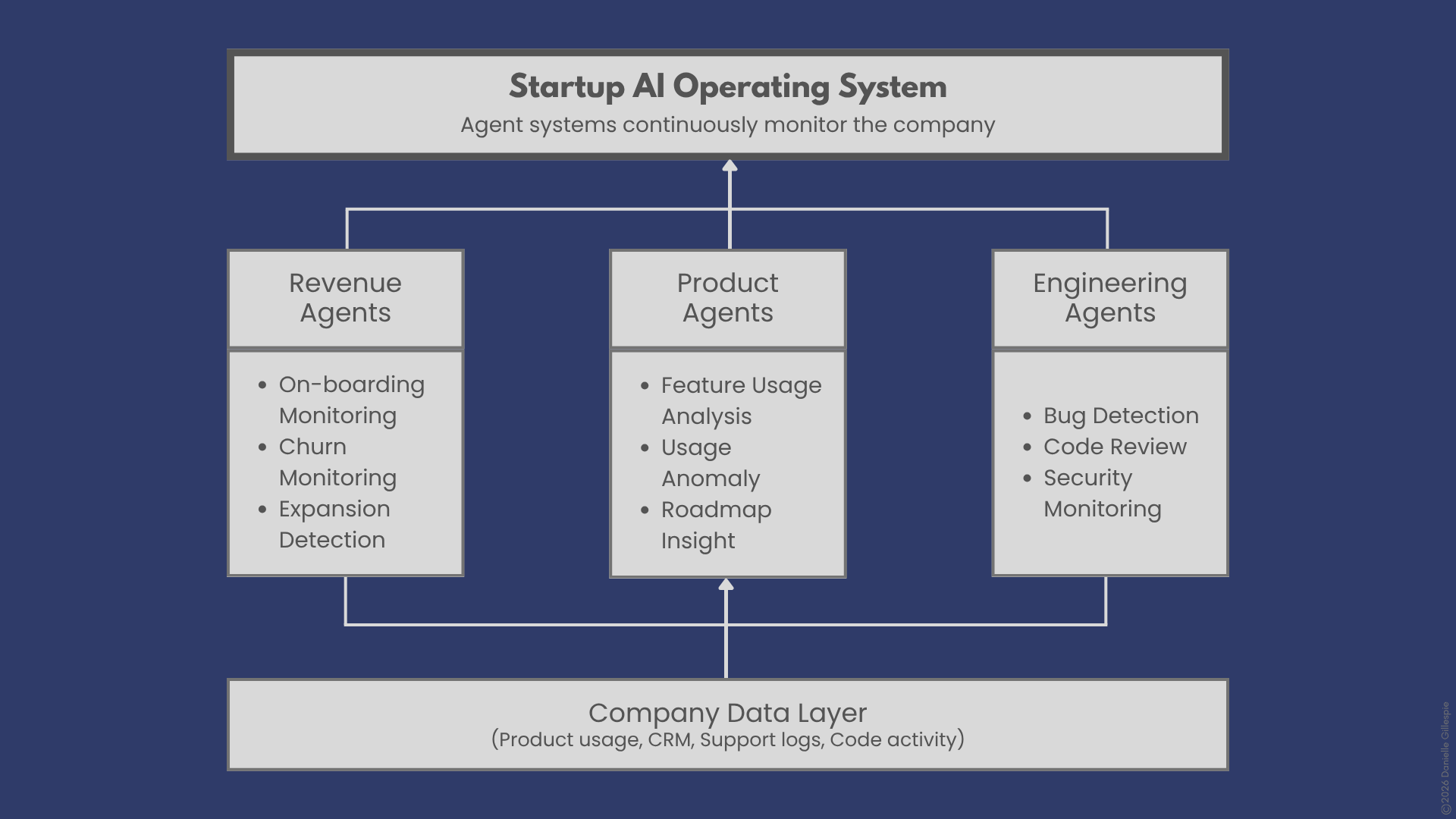
Agents monitor the company across revenue, product, and engineering. Signals are detected automatically and surfaced before humans even start looking.
The real shift isn’t any individual agent, it’s the system of agents. When these agents run together they dramatically reduce time-to-insight, which is the thing that will keep a startup out in front of its competition.
Company Data
Most startups are already collecting enough data for agents to deliver value today.
Agent Domains
When starting to deploy the AI Agent stack, most startups will focus on three core domains.
Revenue Agents to score leads, decide which trials are likely to convert, detect accounts at risk, identify features correlated to churn, multiple team members joining and discovery of features that are being used beyond expectation.
Product Agents to identify on-boarding friction, performance issues, unused features, sudden drops in engagement, and roadmap insights.
Engineering Agents shift focus from code generation to monitoring: analyzing error logs and crash reports, enforcing security best practices, identifying risky deployments and monitoring for any unusual external activity.
AI Agent Operating System
Until now teams have manually searched for insights inside dashboards. AI agents change that. Instead of humans monitoring dashboards, agents continuously monitor the company.
This isn’t a future system. In most startups, many of these pieces already exist, they’re just not connected.
The 5-Layer Startup Architecture
Even though AI agents are categorized into distinct domains, they don’t operate in isolation.
In practice, every AI-native startup begins to have the same underlying architecture. Not tools or dashboards but a continuous intelligence loop.
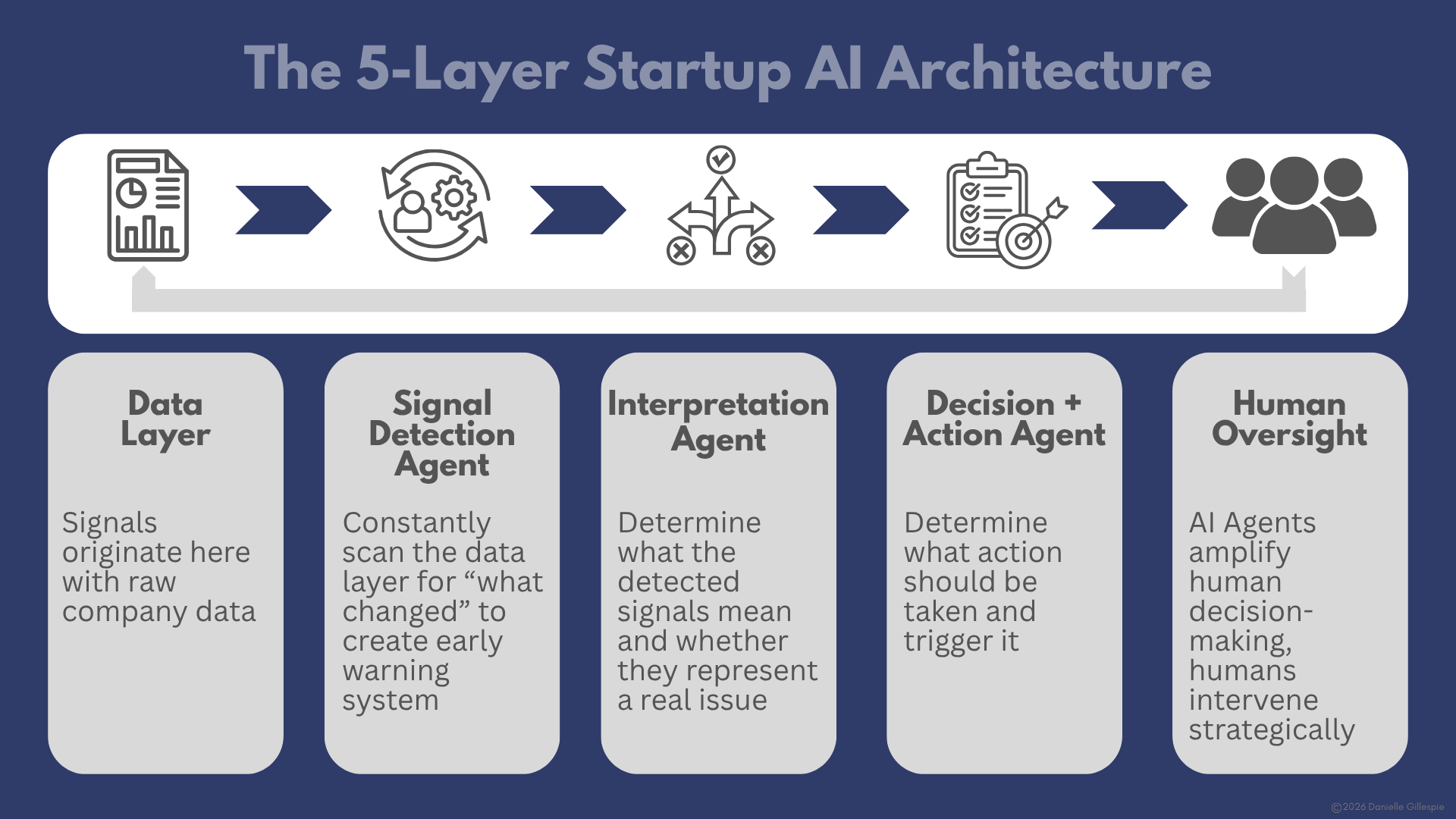
Layer 1: Data Layer
Signals originate here and the AI stack turns data into raw sensory input. Every startup already has this layer:
product analytics
CRM data
billing systems
support logs
code activity
error tracking
Instead of being manually scanned via dashboards, the data is automatically monitored and becomes the foundation for reliable intelligence.
Layer Hack: in practice, most startups can start with just two or three data sources stitched together.
Layer 2: Signal Detection Agent
Agents watch the system continuously and detect patterns humans rarely notice.
Examples include:
Trial conversion dropped for specific user segment
Cluster of accounts showing expansion behavior
New accounts skipping a key onboarding step
Unexpected feature adoption
Churn bottleneck detected
Error rates spiked after a deploy
Although getting this layer right takes some work, the first version does not need to be sophisticated. Even simple thresholds and heuristics are enough to start delivering meaningful value immediately.
Layer 3: Interpretation Agent
This layer converts signals to understanding, determining if the change detected is meaningful or noise. It answers the question of whether this is real or just a random fluctuation.
Example insights that could be surfaced:
New users who skip step 3 in onboarding have a 42% lower retention rate
Accounts using Feature X correlates with expansion
This deployment changed a dependency linked to the recent error spike
This is where most systems fail because interpretation requires context, historical comparison and judgement. Startup teams have most of this information filed away in their heads, articulation becomes important.
Layer 4: Decision + Action Agent
Once patterns are understood, the system proposes actions. Humans decide which actions can be performed automatically and which should be reviewed.
Examples of proposed action:
flag accounts for customer success outreach
recommend upgrade prompts
suggest onboarding improvements
propose roadmap priorities
block risky deployments
escalate incidents
Examples where agents eventually trigger workflows automatically:
creating tickets
message sales teams
trigger outreach
open GitHub issues
launch experiments
Automation is earned, not assumed and it is introduced strategically.
Layer 5: Human Oversight
Humans don’t disappear, but they do become more agile.
As startups gain a deeper understanding of their operations, the level of automation increases. A continuous intelligence loop means that both startups and AI agent stacks become smarter and more efficient.
From Data to Feedback and back to Data again; every cycle improves the system. And better systems equate to compact teams with higher output.
The Mistake Most Startups Will Make
Most startups will build their AI agent stack in the wrong order. They will start with automated actions, but this is a mistake.
Solid intelligence starts with solid data. A data layer that is incomplete and disorganized will result in intelligence that is incomplete and disorganized.
Startups that win will build their systems, one layer at a time, starting with the Data Layer and ending with Automation. Each layer will be edited and iterated until consistent, repeatable results are observed.
Successful startups will build in this order:
Solid data layer: review and critically examine which data is already available and what should be added. Verify accuracy.
Obsess over signal quality: use manual comparison between humans observing dashboard data and what the system is raising as a signal.
Accurate interpretation models: human editors verify that the agent interpretations make sense and add value.
Controlled decision and action agents: agents provide reports that are reviewed and evaluated by humans.
Introduce automation slowly.
The first job of an AI agent stack isn’t to run the company, it’s to understand the company. Skipping steps will be faster but the resulting systems will be broken.
Automating bad decisions at scale is worse than not automating at all.
The Startups That Win Will Build Nervous Systems
As we observe the shift from dashboard monitoring to AI tools to AI agents to AI Operating Systems, we see that companies are beginning to develop something that resembles a nervous system.
Signals travel through the organization continuously, AI agent stacks interpret them, actions happen faster and humans step in where judgment matters most.
Over time, the startups that win won’t just have better products, they’ll have better operating systems.
Instead of asking questions about which AI tools to use and how to add AI features to products, the best founders will be asking what signals the company monitors and how they act on them. In other words, founders will increasingly act as architects of intelligence systems, not just builders of products.
The SaaS era gave startups dashboards. The AI Agent Stack will give them nervous systems.
And the startups that build them first will move and learn faster than everyone else.
A Parting Note
Most teams don’t struggle because of tools. They struggle because they don’t know where to start, or what to trust.
If you’re thinking about building an AI agent system, start small. One signal. One decision. One workflow. That’s where the leverage is.
In the next post, I will break down the first AI agent every startup should build: a churn detection agent. In the meantime, feel free to connect with me if you’re so inclined.
Bonus Founder Section: How to Build Your AI Agent Stack (First 30 Days)
While building a full architecture seems overwhelming, finding a single high-value signal is not.
One high-value signal is how you get the ball rolling. Expanding and iterating is how you keep the ball rolling.
Step 1: Pick One Painful, Measurable Problem
Start with something specific tied to revenue, retention, or engineering. For example:
“Which trials will convert?”
“Which accounts are about to churn?”
“Where are users dropping off in onboarding?”
“Which deployments introduce risk?”
Your problem needs to support a specific decision, otherwise it won’t get used.
Output: one clearly defined signal you want to detect.
Step 2: Think Minimum Viable Data Layer
Do not overbuild, there is no such thing as the perfect amount of data. If you aim for perfection you will stall.
You need just enough structured data to answer one question.
Example data for churn prediction:
product usage (events)
account data (CRM)
billing status
Your goal is not completeness, it’s first signal detection.
Output: a usable dataset that updates regularly.
Step 3: Build a Simple Signal Detector
Now answer the question “What changed?”
Examples:
usage dropped 40% week-over-week
key feature adoption disappeared
login frequency declined
This does not need to be AI-heavy or sophisticated. Simple heuristics and thresholds are enough to deliver value.
Output: a system that flags events without human input.
Step 4: Add Interpretation
Turn signals into meaning by asking “Does this actually matter?” Is the observation noise or is it important.
This is where you introduce AI.
Examples:
“This drop pattern matches past churn behavior”
“This user segment historically fails to convert”
“This error spike correlates with recent deployment changes”
Output: a system that produces useful and trusted insights. Trust your gut, if it doesn’t feel right it probably isn’t there yet.
Step 5: Keep Humans in the Loop (Longer Than You Want)
Before automating anything, force the system to:
generate reports
explain reasoning
be reviewed by humans
Manual review forces you to both train the system and gain a deeper understanding of your operations. Most teams automate too early resulting in faulty systems.
Step 6: Slowly Introduce Action
Once the system is consistently right, slowly introduce automation and start small.
Early automation examples:
create a ticket automatically
flag accounts in CRM
send internal alerts
Vetted automation examples:
trigger customer outreach
launch experiments
block deployments
Reliable decision-making, not automation, is the goal.
Rinse and Repeat
The companies that win won’t start by building AI operating systems. They will start by dominating one layer:
best churn detection
best onboarding intelligence
best expansion signal engine
best engineering risk detection
Then they expand by applying the same structured methodology of signal → interpretation → action → system.
Most startups begin with action and that’s why they fail.
The 30-Day Reality Check
By day 30, you should have:
one signal being detected automatically
one interpretation that is directionally correct
one workflow influenced by the system
humans actively reviewing outputs
If you don’t have this, you’re not building an AI agent stack. You’re still experimenting.
This really makes it clear that the smartest startups aren’t just using AI. They’re building systems that let AI watch, learn, and act across the whole company